Session Ownership
🧷 Session invariant: backend MCP services are local process state keyed by authenticated principal, backend namespace, and downstream MCP session id.
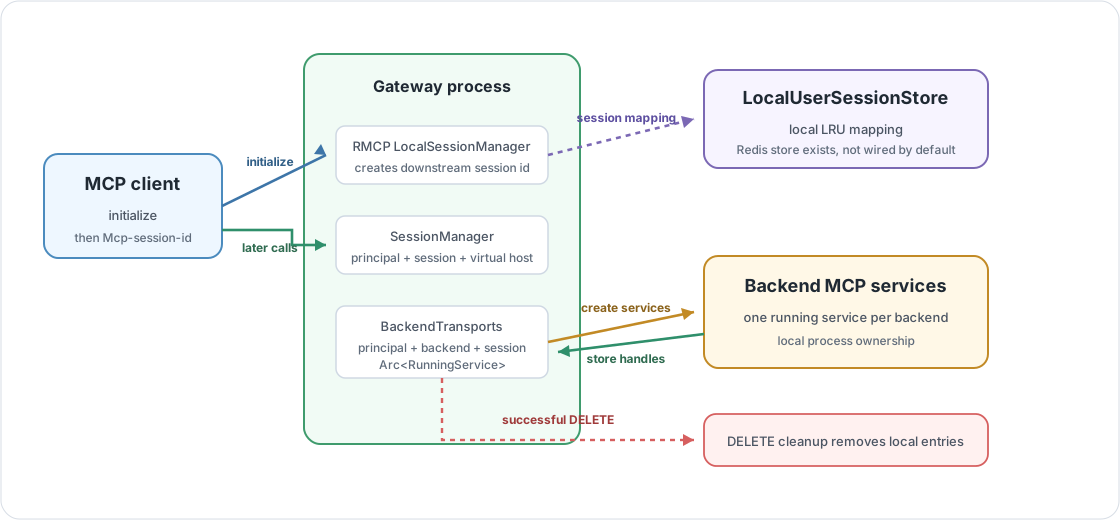
The current gateway keeps backend MCP client services in memory. That choice is simple and fast, but it defines how initialized MCP sessions can be routed in a deployment.
Owned State
Several pieces of state participate in one MCP session. They do not all have the same owner.
| State | Key | Owner today | Lifetime |
|---|---|---|---|
| RMCP downstream session | RMCP DownstreamSessionId and later Mcp-session-id. | RMCP LocalSessionManager. | Local process. |
| User session mapping | UserSession { principal, downstream_session_id }. | LocalUserSessionStore. | Local LRU cache, 50,000 entries, 1 hour. |
| Backend running service | principal + backend_name + session_id. | BackendTransports. | Local process. |
| Backend upstream MCP session | Managed inside RMCP running client service. | Backend service handle. | Local process and backend server. |
RedisUserSessionStore exists, but Gateway::run_gateway wires
LocalUserSessionStore today. Even if the user session mapping moved to Redis,
the live RMCP backend services in BackendTransports would still be local
unless that architecture changes too.
Initialize Creates Backend Services
initialize is the ownership creation point:
InitializeCallValidator
  -> selected VirtualHost
  -> claims.sub
  -> RMCP DownstreamSessionId
  -> one upstream client service per backend
  -> BackendTransports entries
The backend transport key is:
BackendTransportKey
  principal: claims.sub
  backend_name: backend map key
  session_id: downstream session id
The backend map key matters because one downstream MCP session can fan out to many backend MCP sessions. The principal matters because two callers could present the same downstream session id value.
Borrowing Backend Services
SessionManager is a request-scoped view over the selected virtual host,
session id, principal, and shared backend transport map.
| Operation | What it does |
|---|---|
get_backend_names() | Reads backend namespaces from the selected VirtualHost. |
borrow_transports() | Locks the map, finds entries for the current principal/session/backend names, and clones the shared Arc<RunningService>. |
cleanup_backends(reason) | Removes backend entries for the current principal/session/backend names. |
borrow_transports() does not move services out of the map in the current
code. It clones shared service handles, so there is no return step after a
request completes.
List Calls And Routed Calls
Backend service lookup splits into two patterns:
| MCP call shape | Session behavior |
|---|---|
list_tools, list_resources, list_prompts, list_resource_templates | Borrow every available backend service for the selected virtual host, call them concurrently, then merge successful responses with aliases or conditional namespacing. |
call_tool, read_resource, subscribe, unsubscribe, get_prompt, complete | Resolve an explicit tool alias, select the only backend without rewriting, or split a multi-backend prefix; then call the single resolved backend service. |
An initialized backend entry can still contain no running service if backend initialize failed. List calls skip unavailable backends. Routed calls to that backend return a routing error.
If routed lookup ever detects duplicate backend matches, the session is treated
as invalid and cleanup_backends removes the local backend entries for that
principal and session.
Delete Cleanup
session_id_layer owns response-side cleanup for downstream DELETE:
DELETE with Mcp-session-id
  -> let RMCP handle the request
  -> if RMCP response is successful
  -> remove LocalUserSessionStore entry
  -> remove BackendTransports entries for principal + session id
Cleanup is intentionally tied to a successful downstream delete response. If RMCP rejects the delete, the layer returns that response and leaves local session state untouched.
Load-Balancing Consequence
Random load balancing is not safe for stateful MCP sessions today. After
initialize, later requests with the same Mcp-session-id must reach the
process that owns the backend running services.
Known deployment options are:
| Option | Tradeoff |
|---|---|
Sticky routing by Mcp-session-id | Simple, preserves local state, but couples sessions to one process. |
| External session ownership | More flexible, but backend running service state must move out of process or become reconstructible. |
| Reinitialize after failover | Operationally simple, but clients must tolerate session loss. |
Until backend service ownership changes, design request handling as if a stateful MCP session belongs to one gateway process. The same constraint appears inside one host in multi-runtime mode, where each runtime thread owns its own backend transports; see Concurrency And Runtime Model.