Architectural Choices
🧱 Design rule: these choices are not permanent, but changing one should be a deliberate architecture decision with code, tests, and migration notes.
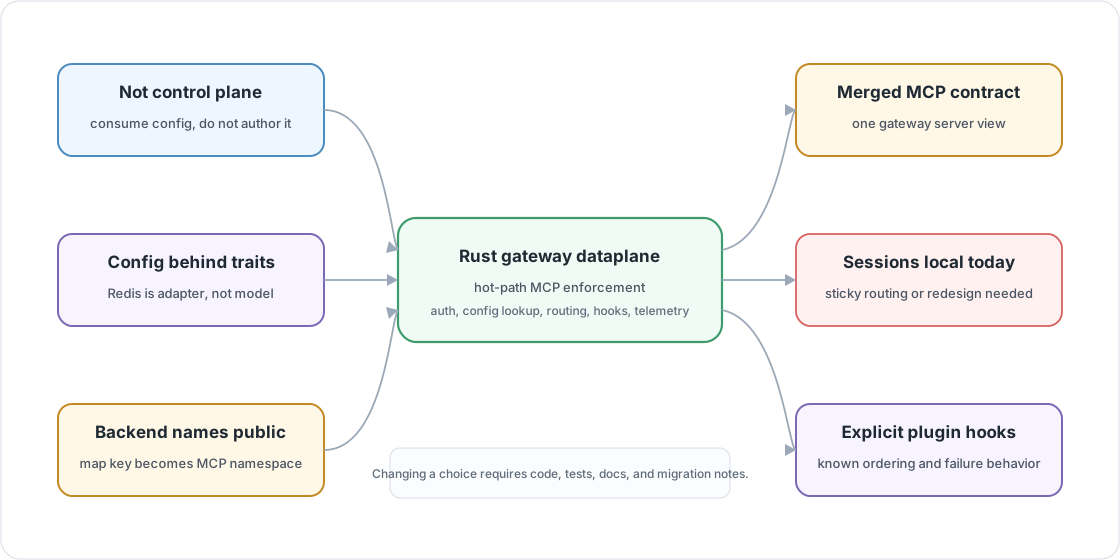
This page records the choices that should stay visible as the gateway evolves. They describe the shape of the current Rust dataplane, not just preferences.
Choice Matrix
| Choice | Current decision | Why it matters |
|---|---|---|
| Dataplane, not control plane | This repo consumes runtime config and handles traffic. It does not own UI, IAM lifecycle, management APIs, or durable observability storage. | Keeps the hot path small and prevents product workflows from leaking into request routing. |
| Config access is abstracted | MCP routing depends on UserConfig, VirtualHost, and UserConfigStore, not Redis commands. | Keeps future xDS/gRPC or another config stream possible. |
| Backend names are public | The backend map key is part of tool/resource/prompt names. | Backend renames are client-visible behavior changes. |
| Sessions are local today | Backend RMCP services live in BackendTransports inside one process. | Load-balanced deployments need sticky routing or a new session ownership design. |
| Merged MCP semantics define the contract | The client sees one gateway MCP server with namespaced backend objects. | Backend topology should not become a hard client dependency beyond the namespace contract. |
| Plugin boundaries stay explicit | Tool pre/post hooks are integrated at known points around backend invocation. | Payload mutation needs clear failure, timeout, cancellation, and telemetry behavior. |
Dataplane, Not Control Plane
The gateway should enforce decisions already made elsewhere:
control plane authors config and policy
  -> Redis/config transport exposes runtime data
  -> Rust dataplane enforces it on MCP traffic
New features should start with one question:
Is this hot-path enforcement, or is this a management workflow?
If it is a workflow, it probably belongs outside this repo. The Rust gateway should enforce the result of management decisions, not become the place where those decisions are authored.
Config Access Is Abstracted
Redis is the current storage and transport adapter. It is not the routing model. The routing model is:
UserConfig
  -> VirtualHost
  -> BackendMCPGateway
That is why request code should stay behind UserConfigStore. Redis key
encoding, MessagePack, cache expiry, and retry settings belong in the adapter,
not in MCP method handling.
Backend Names Are Conditionally Public
Backend map keys are visible in the MCP namespace when multiple backends need disambiguation:
backend map key: gateway-one
backend tool: increment
gateway tool: gateway-one-increment
For a single backend, upstream identifiers pass through unchanged. Explicit
tool_name_aliases published by the control plane take precedence in either
case. Otherwise the map key, not BackendMCPGateway.name, is the namespace
used by multi-backend routing.
Session State Is Local Today
Backend services are not just data. They are live RMCP running services stored under:
principal + backend_name + downstream_session_id
That makes the current state model fast and direct, but not horizontally portable. Do not design request handling as if every node can serve every stateful MCP session until backend service ownership has an external owner or can be rebuilt safely.
Merged MCP Semantics Define The Contract
The downstream client should reason about one MCP server:
client
  -> ContextForge Gateway
  -> merged tools/resources/prompts
Backend identity appears only when namespacing is needed, and clients should not need to know transport details, Redis storage, fanout mechanics, or plugin runtime internals.
This choice leaves room for filtering, policy, and route changes without turning every backend topology change into a client integration change.
Plugin Boundaries Stay Explicit
Plugins can inspect or mutate payloads. That is more powerful than a header filter, so the hook points need to stay obvious.
Current CPEX support is intentionally narrow:
| Hook | Current boundary |
|---|---|
TOOL_PRE_INVOKE | Runs before call_tool forwards to the selected backend. |
TOOL_POST_INVOKE | Runs after call_tool receives a backend result and on backend progress events. |
Avoid adding ad hoc plugin calls in the middle of routing code. If a new hook is needed, define its ownership, failure behavior, timeout behavior, cancellation behavior, streaming behavior, and telemetry attribution.
Transport Security Is Split
Downstream TLS is listener-level process config. Upstream backend security is also process config today, but some of it is naturally backend-specific.
Keep this split visible:
| Concern | Stable owner |
|---|---|
| Gateway listener certificate | Process config. |
| JWT verification keys | Process config. |
| Backend URL, auth headers, pass-through policy, allowed objects | Runtime user config. |
| Backend-specific trust and client identity | Likely runtime config or referenced secret material over time. |
The gateway should not bury transport security decisions inside MCP method handlers. They should remain either startup assembly or explicit backend transport construction.
MCP-First, Not MCP-Only
The current code implements MCP behavior, but the shell is broader:
auth
config lookup
transport setup
plugin runtime
telemetry
session strategy
Keep protocol-neutral concerns reusable. Future A2A or model-provider routing should be able to reuse the gateway shell without copying the MCP routing stack.
When A Choice Changes
Changing one of these choices should update more than one file.
| Change | Expected follow-through |
|---|---|
| Backend namespace changes | Update merge logic, split logic, tests, docs, and migration notes. |
| Session state moves external | Update SessionManager, cleanup behavior, load-balancing docs, and failure-mode tests. |
| Config transport changes | Keep UserConfigStore as the boundary and update adapter tests. |
| Plugin hook surface expands | Document ordering, failure behavior, cancellation, streaming, and telemetry. |
| New protocol joins the gateway | Keep shared shell code protocol-neutral and isolate protocol-specific routing. |
These pages are part of that safety net: they make architecture drift visible before it becomes accidental API behavior.