Backend Connections And Transports
🚚 Transport boundary: downstream listener traffic, upstream backend traffic, and config-store traffic are separate concerns. Keep them separate even when they all use TCP underneath.
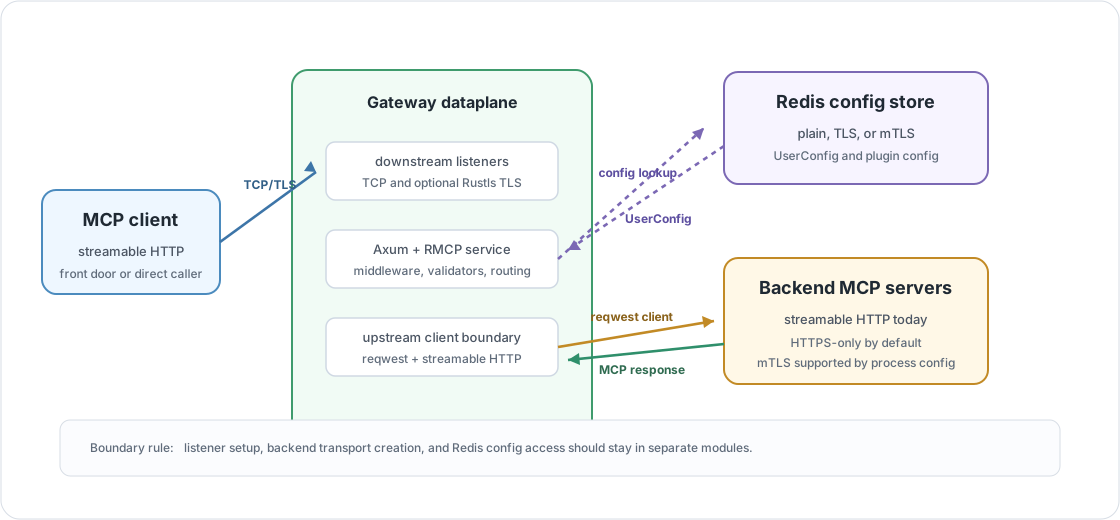
The gateway has three transport classes on the hot path. They are built in different modules, configured from different fields, and serve different architecture roles.
Transport Classes
| Transport class | Current implementation | Main owner | Purpose |
|---|---|---|---|
| Downstream listener | Axum/Hyper over TCP and optional Rustls TLS. | transports/ and Gateway::run_gateway. | Accept MCP streamable HTTP traffic from clients or the front door. |
| Upstream backend | Shared reqwest::Client plus RMCP StreamableHttpClientTransport. | common.rs, gateway/mcp_service/initialization.rs, and gateway/backend_transports.rs. | Open MCP client sessions to configured backend MCP servers. |
| Config store | Redis plain, TLS, or mTLS connection manager. | common.rs and user_config_store/. | Load UserConfig and plugin runtime config from control-plane authored storage. |
The current MCP dataplane only uses streamable HTTP for backend MCP traffic.
BackendMCPGateway.transport already has STREAMABLEHTTP, SSE, and STDIO,
but upstream routing does not branch on that field yet.
Downstream Listeners
Gateway::run_gateway builds one Axum router and can expose it through TCP,
TLS, or both.
| Listener | Config fields | Behavior |
|---|---|---|
| TCP | address | Binds a Tokio TcpSocket, sets reuse options and keepalive, listens with backlog 1024, and serves Axum with graceful shutdown on ctrl_c. |
| TLS | tls_address, server_certificate, server_private_key | Builds a Rustls server config, accepts TLS by hand, then serves the same Axum router through Hyper. |
TLS listener setup has two important constraints:
| Constraint | Why |
|---|---|
tls_address requires both certificate and private key. | The listener cannot build a Rustls server config without both. |
tls_address cannot equal address. | TCP and TLS cannot bind the same socket in this process. |
The downstream TLS listener currently uses with_no_client_auth(). Client
identity is established by the gateway’s bearer JWT layer, not by downstream
mTLS.
Upstream Backend Client
The upstream HTTP client is built once at gateway startup:
Config
  -> reqwest::Client::try_from(&config)
  -> clone per backend initialize task
  -> StreamableHttpClientTransport::with_client(...)
The process-level upstream mode controls whether backend URLs may use plain HTTP, HTTPS, or HTTPS with client identity:
| Mode | reqwest behavior |
|---|---|
| unset | https_only(true). Same as TlsOnly. |
TlsOnly | HTTPS backends only. |
PlainTextOrTls | HTTP or HTTPS backends. |
PlainTextOrMTls | HTTP or HTTPS backends, with a client identity configured for TLS handshakes. |
MtlsOnly | HTTPS backends only, with a client identity configured for TLS handshakes. |
If upstream_trust_bundle is configured, the PEM bundle is merged into the
client’s TLS trust roots. For mTLS modes, the upstream certificate and private
key are read from disk and combined into a reqwest::Identity.
Backend MCP Transport
During initialize, the selected virtual host fans out to every configured
backend:
VirtualHost.backends
  -> for each backend URL
  -> build StreamableHttpClientTransportConfig
  -> serve GatewayBackendClient over StreamableHttpClientTransport
  -> store running service in BackendTransports
For HTTPS backend URLs, the gateway also sets a custom Host header from the
backend URL host and optional port. HTTP backend URLs do not get this custom
header in the current code.
Backend connection failures are not fatal to the whole initialize call. The gateway stores the backend entry with no running service, so list calls can continue with available backends and routed calls to that backend can fail locally.
Config-Store Transport
Redis is the current config-store transport. It is used for user config and, when runtime plugins are enabled, plugin runtime config.
| Redis mode | Connection behavior |
|---|---|
PlainText | Connects to host:port over TCP. |
Tls | Connects with rediss://host:port and a required trust bundle. |
Mtls | Connects with rediss://host:port, required trust bundle, required client certificate, and required client key. |
The Redis user config adapter stores:
MessagePack(User::new(claims.sub)) -> MessagePack(UserConfig)
The Redis connection manager is configured with 1,000 retries. The adapter
keeps an in-process LRU cache in front of Redis, but routing code should only
depend on the UserConfigStore trait.
What Should Move To Runtime Config
Transport security is mostly process config today. That keeps startup simple, but it is not the final shape for every backend-specific decision.
| Setting | Today | Better long-term owner |
|---|---|---|
| Downstream TLS certificate | Process config. | Process config. It belongs to the gateway listener. |
| Upstream trust bundle and mTLS identity | Process config. | Runtime config per backend or referenced secret material. |
| Backend auth headers | Not applied from UserConfig yet. | Runtime config per backend. |
| Backend transport type | Model field exists, not routed yet. | Runtime config per backend. |
| Header pass-through policy | Model field exists, not enforced yet. | Runtime config per backend or route policy. |
The boundary to preserve is simple: listener code should not know Redis schema, MCP routing code should not know Redis command details, and backend transport creation should stay behind a small, explicit upstream boundary.