APL: configuring enforcement pipelines#
APL is the declarative configuration that defines a CPEX enforcement pipeline. Each capability an agent can invoke (a tool, resource, prompt, or A2A method) defines its own pipeline through a route that sequences the controls protecting it, evaluated at the boundary. You describe the conditions and the effects; you do not write enforcement logic in application code.
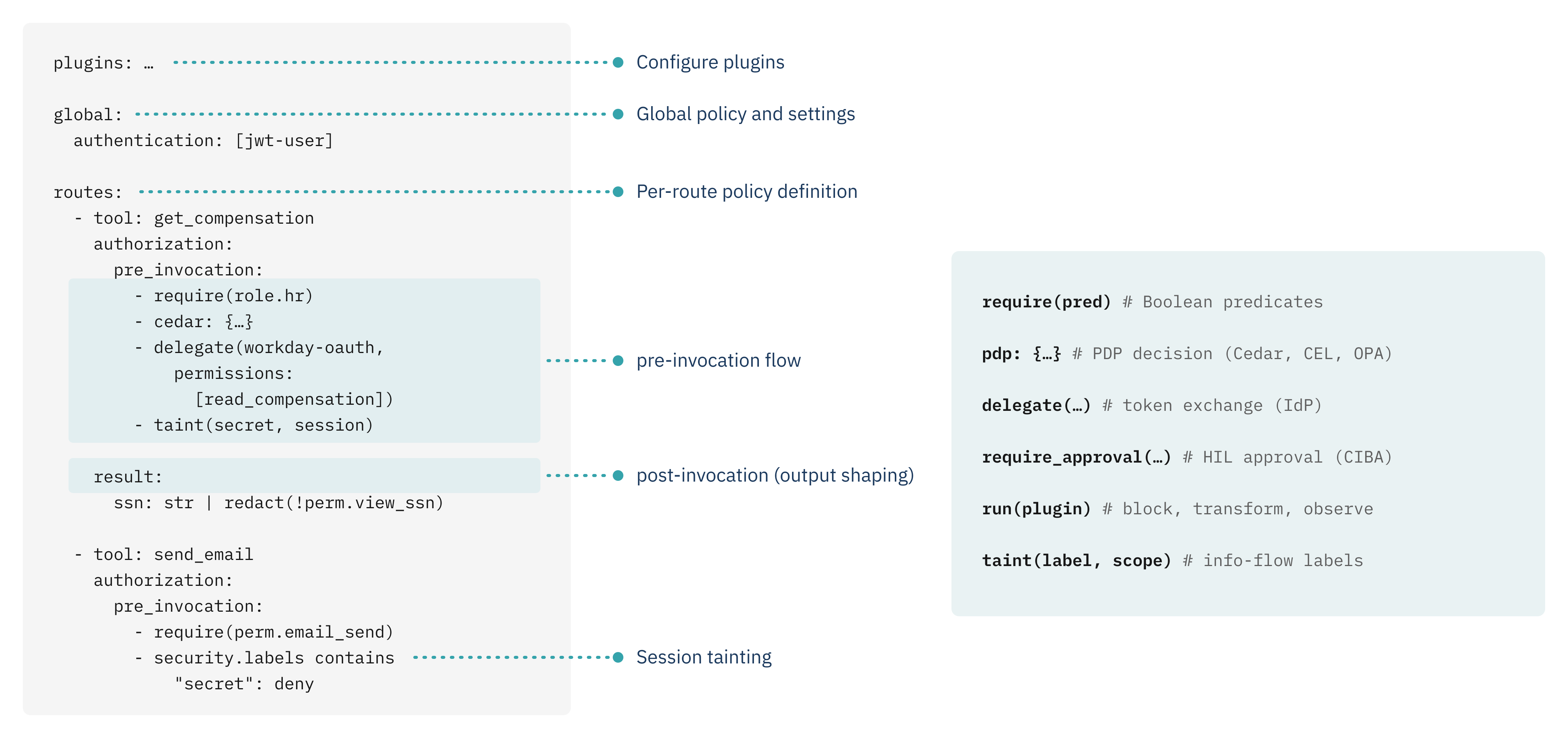
This page covers the configuration: routes, phases, predicates, rules, and field pipelines. The rest of this section goes deeper on each kind of policy:
- Effects & Sequencing: the effects a rule can run, halt-on-deny ordering, and composition.
- PDP Integration: hand a decision to Cedar, CEL, or an external engine.
- Identity & IdP: how callers are resolved into the attributes predicates read.
- Static Attributes: operator-maintained config facts in the
data.*namespace. - Delegation: mint scoped downstream credentials via token exchange.
- Elicitation: pause an operation for human approval and resume on retry.
- Session Tainting: information-flow control across requests.
- Backend Restriction: shape which backends the router may select for a request.
Routes and phases#
Policy is organized by route: an operation CPEX mediates, identified by the tool, A2A method, or other interface it governs. Each route runs through four phases, in order:

- args: validate and transform request inputs before the operation runs.
- authorization.pre_invocation: authorize the operation. Predicates, PDP calls, delegation, tainting.
- result: transform the response. Redaction and masking on the wire.
- authorization.post_invocation: checks after the result is known. Audit, post-delegation verification.
The first deny in any phase halts that phase and every later phase. Nothing reaches the backend after a deny in args or authorization.pre_invocation.
authorization names when the phase runs, not a pure allow/deny gate: alongside the decision, pre_invocation (and post_invocation) can carry obligations and effects — taint(...), delegate(...), and plugin(...) (which may transform the payload) — that run as part of the phase.
routes:
  - tool: get_employee
    args:
      employee_id: "str"
    authorization:
      pre_invocation:
        - "require(authenticated)"
        - "delegation.depth > 2: deny"
    result:
      ssn: "str | redact(!perm.view_ssn)"
      salary: "int | redact(!role.hr)"
      employee_id: "str | mask(4)"
The pre_invocation: / post_invocation: lists may also be written flat on the route (without the authorization: wrapper); both forms are equivalent.
Predicates#
A predicate reads attributes resolved from the caller’s identity and request context (see Identity for where attributes come from). The forms:
- Truthiness: a bare attribute is true when present and truthy.
authenticated,role.hr,perm.view_ssn. - Comparison:
delegation.depth > 2,client.trust_level == 'trusted'. Operators:==,!=,>,>=,<,<=. - Set membership:
subject.id in authorized_users,subject.id not in banned_list. - Existence:
exists(delegation.origin_subject_id)is true when the attribute is present. - Containment:
security.labels contains "secret". - Logical composition:
&(and),|(or),!(not). Precedence is()>!>&>|.
- "(role.hr | role.security) & !delegated"Rules#
A pre_invocation: (or post_invocation:) entry is a rule. Two forms:
require(...) denies unless the predicate holds:
- "require(authenticated)"
- "require(role.hr)"
- "require(!delegated)"
require(a, b) denies if either is false (an implicit and). require(a | b) denies only if both are false.
predicate: effect runs the effect when the predicate holds:
- "delegation.depth > 2: deny"
- "security.labels contains \"secret\": deny('session touched secret data', 'session_tainted')"
deny takes an optional reason and code: deny, deny('reason'), or deny('reason', 'code'). The code is surfaced to the caller and the audit log.
For richer conditionals, use the when / do form, where do is a single effect or a list:
- when: "role.hr & !perm.view_ssn"
  do:
    - "taint(restricted, session)"
    - "plugin(audit-log)"
Custom denial response#
By default a deny surfaces a reason and code, and the host renders its own denial. A route can instead attach a custom HTTP response — status, body, headers — through a response: block, a sibling of the route’s authorization: block:
routes:
  - tool: locked
    authorization:
      pre_invocation:
        - "require(authenticated)"
    response:
      status: 403
      body: "{\"error\":\"forbidden\"}"
      headers:
        WWW-Authenticate: "Bearer"
All three fields are optional; an absent block leaves the host’s default denial unchanged. When the route denies, the status/body/headers are carried on the violation for the host to render on the wire. response: is honored at route scope and at global scope (below); it is inert — and warns at load time — under defaults or a policy bundle. It is scope-local: a global response: is not inherited by entity routes.
Authorizing HTTP requests without an entity#
Routes key on an MCP / A2A entity — a tool, prompt, resource, or LLM. A generic HTTP request that carries no such entity is authorized by the global policy instead: when global declares an authorization: (or args:) block, CPEX evaluates it for these requests, reading the request line (http.method, http.path, http.host, http.scheme) and headers. Pair it with a global response: to return a custom denial.
global:
  authorization:
    pre_invocation:
      - "http.method != 'GET': deny"
  response:
    status: 405
    headers:
      Allow: "GET"
The host must populate http.host from a validated request authority, never a raw client Host header, so host-based predicates cannot be spoofed by the caller.
Field pipelines#
args: and result: map a field to a pipeline of stages separated by |. Stages run left to right; a failed validator denies the phase.
result:
  ssn: "str | redact(!perm.view_ssn)"
  email: "email"
  employee_id: "str | mask(4)"
The accepted stages:
| Category | Stages |
|---|---|
| Type validators | str, int, bool, float, email, url, uuid |
| Constraint validators | enum(a, b, c), regex("..."), len(1..100), range like 0..100 |
| Transforms | mask(N) (keep last N), redact, redact(!predicate) (redact unless), omit, hash |
| Scans | pii.redact, pii.detect, injection.scan |
| Dispatch | plugin(name) (alias run(name)), taint(label[, scope]) |
Named-validator dispatch (validate(name)) is not implemented in the current build. Use regex("...") for pattern checks or plugin(name) to hand a field to a plugin.
Effects beyond predicates#
A pre_invocation: rule can also call a PDP, mint a delegated token, or invoke a plugin. Those effects and how they sequence are covered in Effects.
Every fragment on this page is drawn from the apl-core parser tests and the reference deployments, so the forms shown here parse as written.