Runtime Configuration
🗂️ Config boundary: process config tells the gateway how to run. Runtime user config tells each request where it may route. Plugin config controls the optional CPEX hook runtime.
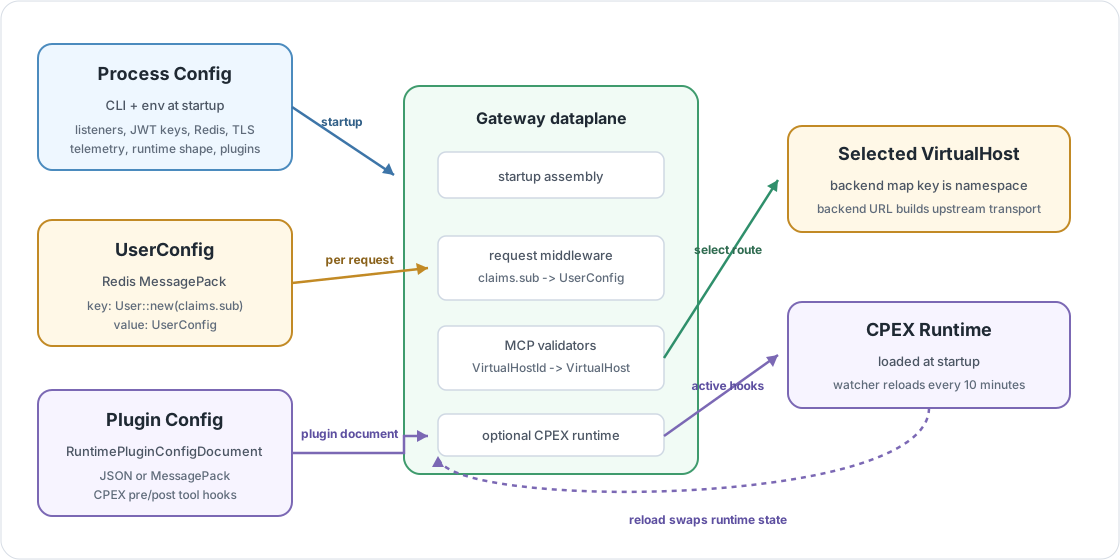
The gateway consumes configuration from three places. Keeping them separate is important because they change at different times and are used by different parts of the dataplane.
Config Surfaces
| Surface | Source | Loaded | Main user |
|---|---|---|---|
Process Config | CLI flags and CONTEXTFORGE_GATEWAY_RS_* env vars parsed by clap. | Startup. | Listener setup, JWT decoder keys, Redis connection, upstream HTTP client, telemetry, runtime shape. |
UserConfig | UserConfigStore, currently Redis through RedisUserConfigStore. | Per request after JWT validation. | Virtual host and backend selection. |
RuntimePluginConfigDocument | Redis key ContextForgeGatewayRuntimePluginConfig when runtime plugins are enabled. | Startup and watcher reload. | CPEX tool pre/post hooks. |
The control plane owns durable authoring. This repo owns reading those values and applying them on the request path.
UserConfig Shape
The API crate defines the shared runtime routing model:
UserConfig
  virtual_hosts: HashMap<String, VirtualHost>

VirtualHost
  backends: HashMap<String, BackendMCPGateway>

BackendMCPGateway
  name: String
  url: Url
  transport: Transport
  passthrough_headers: Vec<String>
  allowed_tool_names: Vec<String>
  allowed_resource_names: Vec<String>
  allowed_prompt_names: Vec<String>
Transport currently declares:
STREAMABLEHTTP
SSE
STDIO
The Rust types above are easier to picture as JSON. For a complete, working
UserConfig document, see the seed request body in
Run the Gateway Locally.
What The MCP Dataplane Uses Today
The struct is already wider than the current MCP routing code. That is useful, but the distinction should stay explicit:
| Config field | Current MCP dataplane behavior |
|---|---|
UserConfig.virtual_hosts | Required. VirtualHostId from the path selects one entry. |
VirtualHost.backends map key | Required. Selects backend session state and becomes the public prefix when a multi-backend identifier has no explicit alias. |
BackendMCPGateway.url | Required. Used to build the upstream StreamableHttpClientTransport. |
BackendMCPGateway.name | Present in the model. Current routing uses the backend map key, not this field, as the namespace. |
transport | Present in the model. Current upstream code always builds a streamable HTTP client transport. |
passthrough_headers | Present in the model. Current MCP routing does not apply header pass-through policy from this field. |
allowed_tool_names | Present in the model. Current list/call routing does not enforce it. |
tool_name_aliases | Optional exact {downstream_alias: upstream_original} mapping used by tool list/call routing before the single-versus-multi-backend fallback. |
allowed_resource_names | Present in the model. Current resource routing does not enforce it. |
allowed_prompt_names | Present in the model. Current prompt routing does not enforce it. |
The current route selection is:
JWT subject
  -> User::new(subject)
  -> UserConfig
  -> path VirtualHostId
  -> VirtualHost
  -> backend map key
  -> BackendMCPGateway.url
Expected config growth beyond the current fields:
- route selection across multiple MCP endpoints
- principal/virtual-host filters for tools, resources, and prompts
- backend auth/TLS material references
- request/response header pass/add/remove rules
- plugin/CPEX hook settings
- pagination/SSE behavior where protocol handling needs config
- future A2A and LLM routing/provider settings
Redis Storage
RedisUserConfigStore stores user routing config as MessagePack:
| Item | Encoding |
|---|---|
| Redis key | MessagePack-encoded User::new(jwt_subject). |
| Redis value | MessagePack-encoded UserConfig. |
| Cache key | Raw subject string through User::key(). |
| Cache value | Decoded UserConfig. |
The in-process cache is an implementation detail:
| Setting | Value |
|---|---|
| Entries | 50,000 |
| Expiry | --user-config-cache-expiry-seconds, default 60 seconds; 0 disables caching |
| Redis connection retries | 1,000 |
Routing code should stay behind the UserConfigStore trait. That keeps Redis,
MessagePack, and cache behavior out of MCP method handling.
Plugin Runtime Config
When runtime_plugins_enabled is true, startup builds a
CpexRuntimeRegistry::with_redis_config(...). The registry reads a separate
runtime plugin document:
Redis key: ContextForgeGatewayRuntimePluginConfig

RuntimePluginConfigDocument
  version: 1
  cpex: CpexConfig
The plugin config loader accepts JSON bytes or MessagePack bytes. It rejects
documents with the wrong version, missing cpex config, unsupported CPEX
features, or an unavailable config store.
Current supported plugin scope is deliberately narrow:
| CPEX feature | Current support |
|---|---|
TOOL_PRE_INVOKE | Supported for call_tool before backend invocation. |
TOOL_POST_INVOKE | Supported for call_tool responses and backend progress events. |
| CPEX routing | Rejected. Gateway routing is owned by UserConfig and MCP routing code. |
| Plugin conditions | Rejected. |
| Plugin dirs, global policies, global defaults | Rejected. |
| Other hook types | Rejected. |
The registry has a watcher interval of 10 minutes. On valid reloads it swaps in the new runtime. On invalid reloads it marks the runtime failed so new plugin calls return an internal MCP error until a valid config is applied.
Process Config
Process Config is not per-user routing state. It is parsed once and controls
the gateway shell:
| Area | Examples |
|---|---|
| Listener | address, tls_address, downstream TLS certificate and private key. |
| Authentication | RSA public key path or HMAC secret for JWT verification. |
| Redis | Host, port, plain/TLS/mTLS mode, trust bundle, client cert, client key. |
| Upstream HTTP client | Plaintext/TLS/mTLS mode, upstream trust bundle, client cert, client key. |
| Telemetry | OpenTelemetry traces, metrics endpoint/protocol, OTLP headers, service name. |
| Runtime shape | CPU count and single-runtime versus multi-runtime mode. |
| Plugins | Whether runtime plugins are enabled. |
| Logging | Log name and rotation. |
The process config decides whether the gateway can start and what dependencies
it can reach. It does not decide which backend a specific MCP caller may use;
that remains in UserConfig.
Selection Invariant
Backend selection should only happen after these facts exist:
authenticated subject
  + loaded UserConfig
  + path VirtualHostId
  + MCP session context
That invariant is why runtime config access is in middleware and MCP validators, not hidden inside individual backend calls.