Authentication And User Config Lookup
🔐 Boundary: authentication proves who is calling. User config lookup decides which virtual hosts and backends that caller can reach.
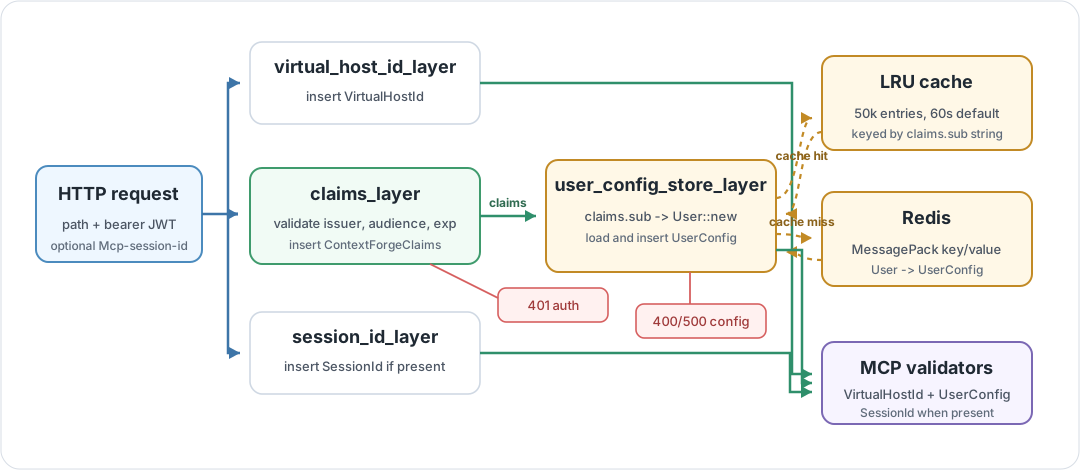
This page follows the identity boundary in the request path. The gateway does
not let an MCP method choose arbitrary backend URLs. It validates the bearer
token, loads the caller’s UserConfig, and only then lets MCP validators select
a virtual host from that config.
Request Order
Authentication and config lookup happen before McpService handles the MCP
method:
| Step | Code | Output |
|---|---|---|
| Path context | virtual_host_id_layer | VirtualHostId extension. |
| JWT validation | claims_layer | ContextForgeClaims extension. |
| Session header | session_id_layer | Optional SessionId extension. |
| Config lookup | user_config_store_layer | UserConfig extension. |
| Virtual host check | virtual_host_config_layer | 404 when the path’s virtual host id is not in the loaded config. |
| MCP validation | InitializeCallValidator or AuthorizedCallValidator | Selected VirtualHost, session id, and claims. |
The order matters: user_config_store_layer needs ContextForgeClaims, and MCP
validators need both UserConfig and VirtualHostId.
Token Validation
claims_layer reads Authorization: Bearer ... and decodes the JWT with the
algorithm declared in the JWT header.
| Token property | Current behavior |
|---|---|
| Algorithm | Accepts RS256/RS384/RS512 when an RSA public key is configured, or HS256/HS384/HS512 when a shared secret is configured. |
| Issuer | Must match mcpgateway. |
| Audience | Must match mcpgateway-api. |
| Expiration | exp is validated. |
| Unsupported algorithm | Rejected before claims are inserted. |
The decoded value is stored as ContextForgeClaims. The fields currently
important to routing are:
| Claim | Routing role |
|---|---|
sub | Becomes the user config key and the principal for backend session lookup. |
iss, aud, exp | Authentication checks only. |
jti, token_use, iat, teams, user, scopes | Carried in claims for future policy use; not currently used by MCP routing. token_use, iat, teams, and scopes are optional, as is user.full_name, so tokens without those fields still validate. |
A concrete decoded payload for the local admin@example.com subject looks like
this (timestamps shown as example Unix seconds). Of everything here, MCP routing
depends only on sub today. The optional fields are included for illustration:
{
  "iss": "mcpgateway",
  "aud": "mcpgateway-api",
  "sub": "admin@example.com",
  "exp": 1717180800,
  "iat": 1717177200,
  "jti": "example-token",
  "token_use": "api",
  "teams": ["team_awesome"],
  "user": {
    "email": "admin@example.com",
    "full_name": "API Token User",
    "is_admin": true,
    "auth_provider": "api_token"
  },
  "scopes": {
    "server_id": "my_id",
    "permissions": ["tools.read", "servers.use"],
    "ip_restrictions": ["192.169.1.0/24"],
    "time_restrictions": null
  }
}
User Config Key
user_config_store_layer turns the subject into a typed key:
ContextForgeClaims.sub
  -> User::new(subject)
  -> UserConfigStore::get_config(&user)
The Redis adapter serializes that User key with MessagePack. The key includes
both the key type and the subject, so user config data is not just stored under
the raw subject string.
Cache And Redis Lookup
RedisUserConfigStore checks an in-process LRU cache before going to Redis:
| Stage | Behavior |
|---|---|
| LRU hit | Clone the decoded UserConfig from the cache. |
| LRU miss | MessagePack-encode User::new(subject), GET that Redis key, decode the MessagePack UserConfig, then cache it. |
| Cache size | 50,000 entries. |
| Cache expiry | --user-config-cache-expiry-seconds, default 60 seconds. 0 disables the cache and reads Redis on every request. |
| Redis retry setting | Connection manager is configured with 1,000 retries. |
The cache is an implementation detail of RedisUserConfigStore. Routing code
depends on UserConfigStore, not Redis commands.
Failure Behavior
Failures before RMCP method handling are HTTP responses:
| Failure | Response |
|---|---|
Missing Authorization header | 401 Unauthorized. |
Header does not start with Bearer | 401 Unauthorized. |
| JWT header or body cannot be decoded | 401 Unauthorized. |
| JWT uses an unsupported algorithm | 401 Unauthorized. |
| Required decoder key or secret is not configured | 401 Unauthorized. |
No user config exists for claims.sub | 400 Bad Request. |
| Redis/config store error other than missing data | 500 Internal Server Error. |
user_config_store_layer runs without claims | 400 Bad Request. |
| Virtual host id not present in the caller’s config | 404 Not Found with body {"detail":"Server not found"}. |
A valid user config can still fail a request: virtual_host_config_layer
returns 404 before MCP method handling when the config does not contain the
path’s VirtualHostId.
What This Boundary Does Not Do
Authentication and user config lookup do not route to a backend by themselves. They only establish:
caller identity
  + caller UserConfig
  + requested VirtualHostId
McpService still has to validate the MCP call, resolve the virtual host, and
choose either the initialize path, routed backend path, or local method path.